Blog
Mourn the System
6/23/2026
The AI boom is opening some people's eyes on how far our economic system is willing and able to go. Cutting off households for data center power, completely ignoring emissions targets, making consumer electronics prices surge. System is the leading word in that sentence, because while there are some idiosyncratic manchilds at the helm, the root cause is a free market capitalism that we have allowed to literally and figuratively exploit our civil rights, social lives and infrastructure. Many people react to this in horror, and understandably so.
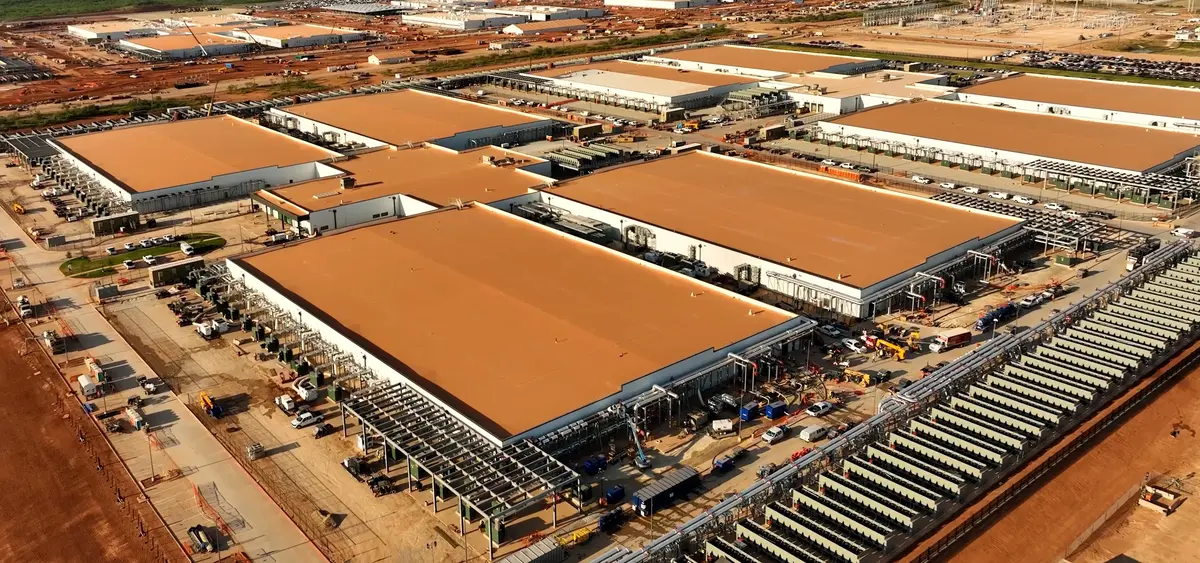 OpenAI's main "Stargate" facility in Abilene, Texas, image by OpenAI
Memoirs of a vegetarian
These things had not escaped me, but didn't phase me as much. Having been a vegetarian for over 15 years, I can strongly recall initially feeling a similar loss; becoming aware of things disappearing (dying) in the world at the hands of other humans. 900.000 Cows, 3.8 million pigs and 202 million chickens are slaughtered every day. And the casualties aren't just livestock. The industry is responsible for over 3 Gigatonnes of CO₂-equivalent per year (much more than aviation at about 1 Gt per year), and these emissions lead to millions of (human) deaths according to the World Health Organisation. Compared to this, let alone the much bigger polluter of automotive, AI data centers have only made their first dent.
Responding to loss
I do not include these figures to shock you, or to convince you to become a vegetarian, but rather to emphasise that the feeling that something of value is lost in the world is real and valid, and outrage is justified. The topic of this article is something else: how we can reconcile the witnessing of loss at such enormous scale with a positive outlook and creative energy in our personal lives? The answer to catastrophy cannot be to give up, surely. But the more commonly seen response is to put one's head in the sand, and that was something that was never an option for me either. Though some downright stubbornness of character is to blame, reading Ginie Servant-Miklos's work opened my eyes to another aspect of dealing with reality: the ability to mourn.
We have to learn to mourn
Mourning is the emotional expression to an event of loss. Mourning is not suppression or denial, it is confrontative and honest. Mourning in a healthy way is an inescapable part of life in general, but particularly so in times of decline or crisis.
Vegetarians know what it is like to mourn. Being continuously confronted with the death of something you consider to have value by the world that surrounds you forces it on you. Some vegetarians have the illusion of a future vegetarian or vegan world. But those of us less idealistically inclined, face the reality that industrialised meat consumption will be the norm or even the expectation wherever we go for decades or centuries to come.
All vegetarians have (silentely) asked the question: are the omnivorous people around me evil? Some have concluded affirmatively, and hence kicked them out of their social circles, but I'm not sure. I believe people are good and systems can make them do things they would not do by their own initiative. There's a nice post-1945 catalogue of psychology to read about that. But more importantly: we are not the judges of other people's moral character. We don't know all of each others stories. When we share those stories, we learn that everyone has experienced loss.
Rise from the ashes
Collapsology is the field of study of the risks of collapse of industrial civilization. Contributors to this field pre-assume that loss is already part of the world as we know it, and study the ways and likelihoods of this loss rapidly accelerating in the face of industrialisation and its environmental effects. Collapsology is not fatalism or defeatism. Knowing the world as we know it may disappear, can also shine a light on the world as we do not know it yet. Instead of sustainability as the stern proctor supposed to save the current system, it can be the joyful heart and spirit of a new one. Resistance is not futile if it creates.
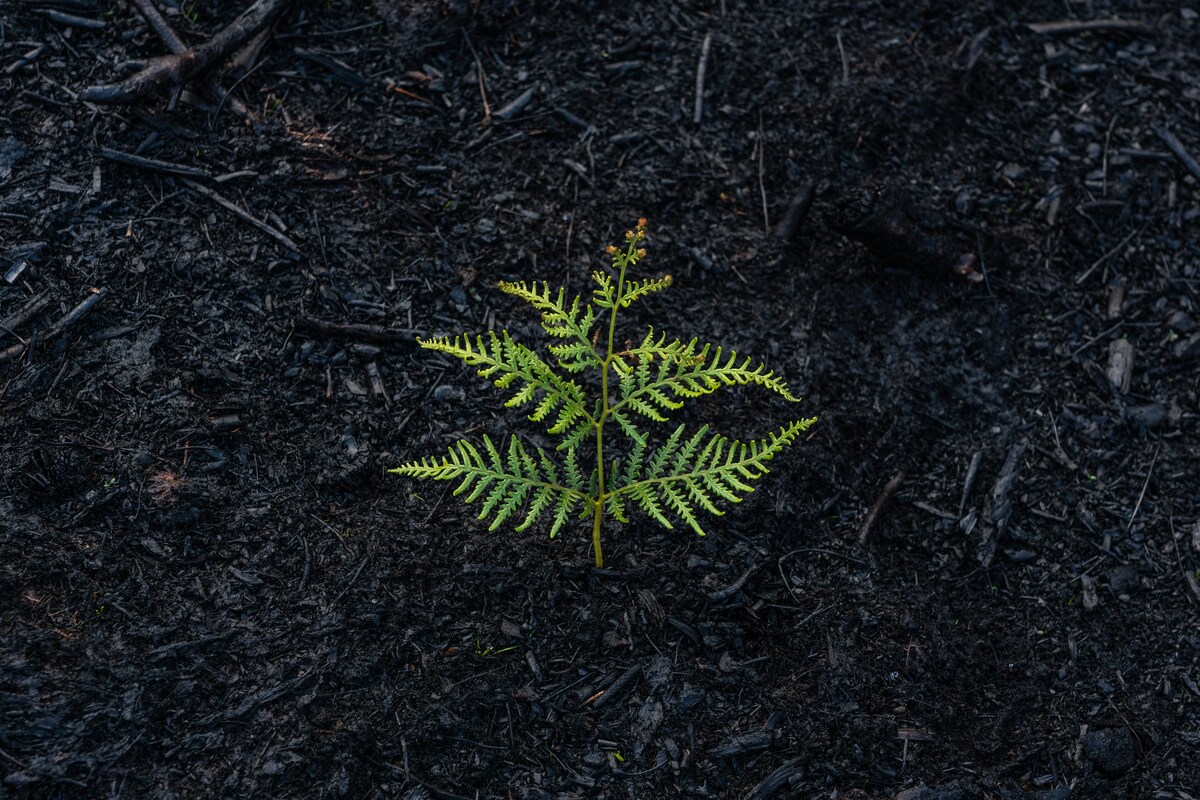 A fern grows from ashes after significant bushfires in Tasmania, Australia, by Matt Palmer
We need to be able to mourn what we are losing, to regain positive energy and creativity without being in denial. History is the repetition of the rise and fall of worlds. The collapse of one may be the interlude of another. And even without it, the burning real world has more beauty in it than the perfect dreamed one.